
Role: Lead Product Designer
Tools: Figma, Figjam, AI-Tools (Claude)
Team: Founders, GTM, Forward-Deployed Engineers, Product, Engineering
Timeline: Nov 2025 – Jan 2026
Enable Self-Serve: Unified Delivery
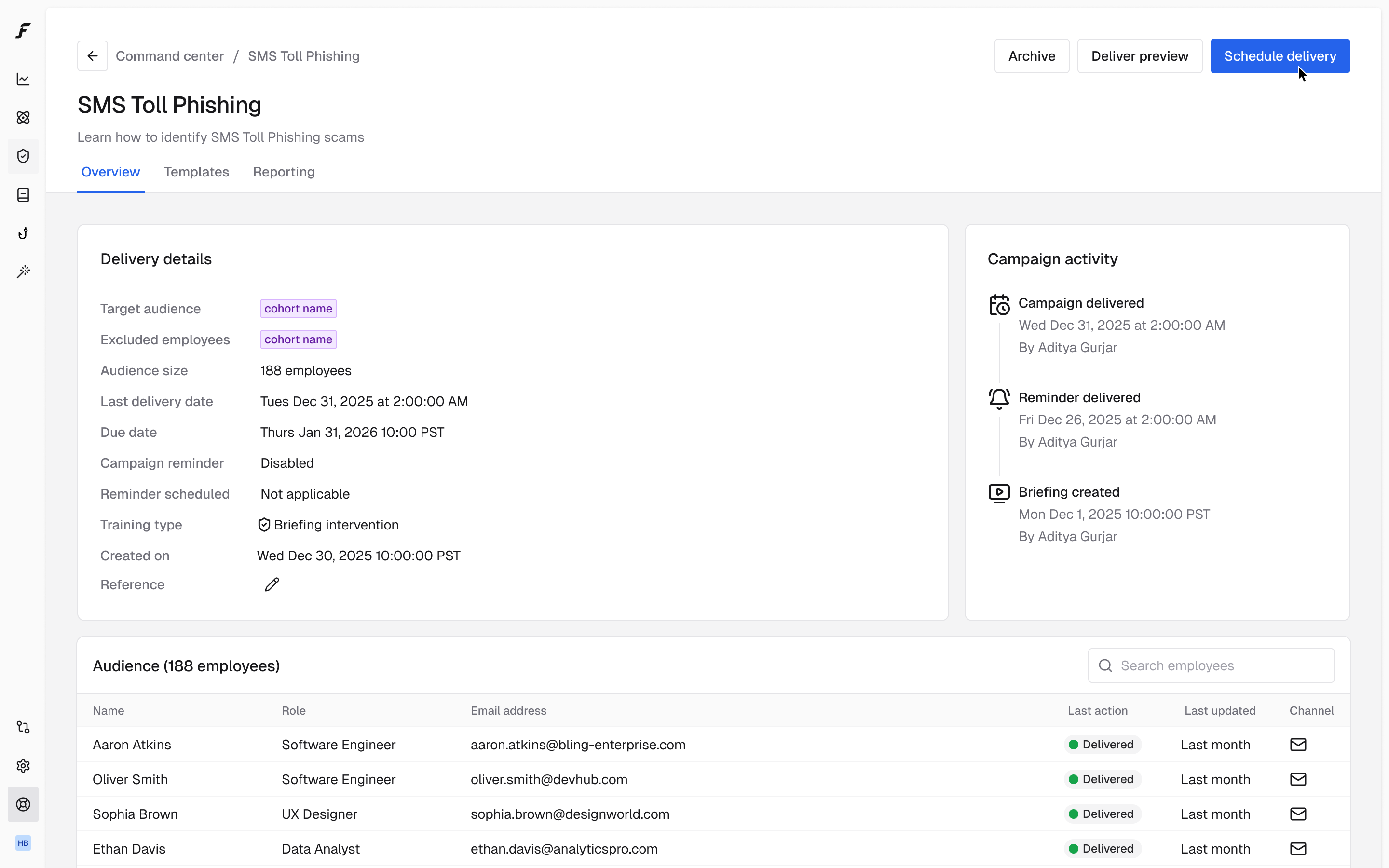
Fable Security is a Human Risk Management platform that detects risky employee behavior and delivers targeted interventions (micro-briefings, simulations, nudges) then measures whether behavior actually changed. After Fable announced its Series A in July 2025, the company shifted from building product to scaling go-to-market. This project focused on addressing campaign delivery and enable customers to self-serve without GTM/FDE support.
Responsibilities
I was the product designer leading design at Fable. I ran the product assessment end to end which became the foundation of the Q3 roadmap. Based on the investigation, I designed of the unified delivery experience through release, partnering with FDEs, GTM, product management, and the founders.
PROBLEM STATEMENT
The problem
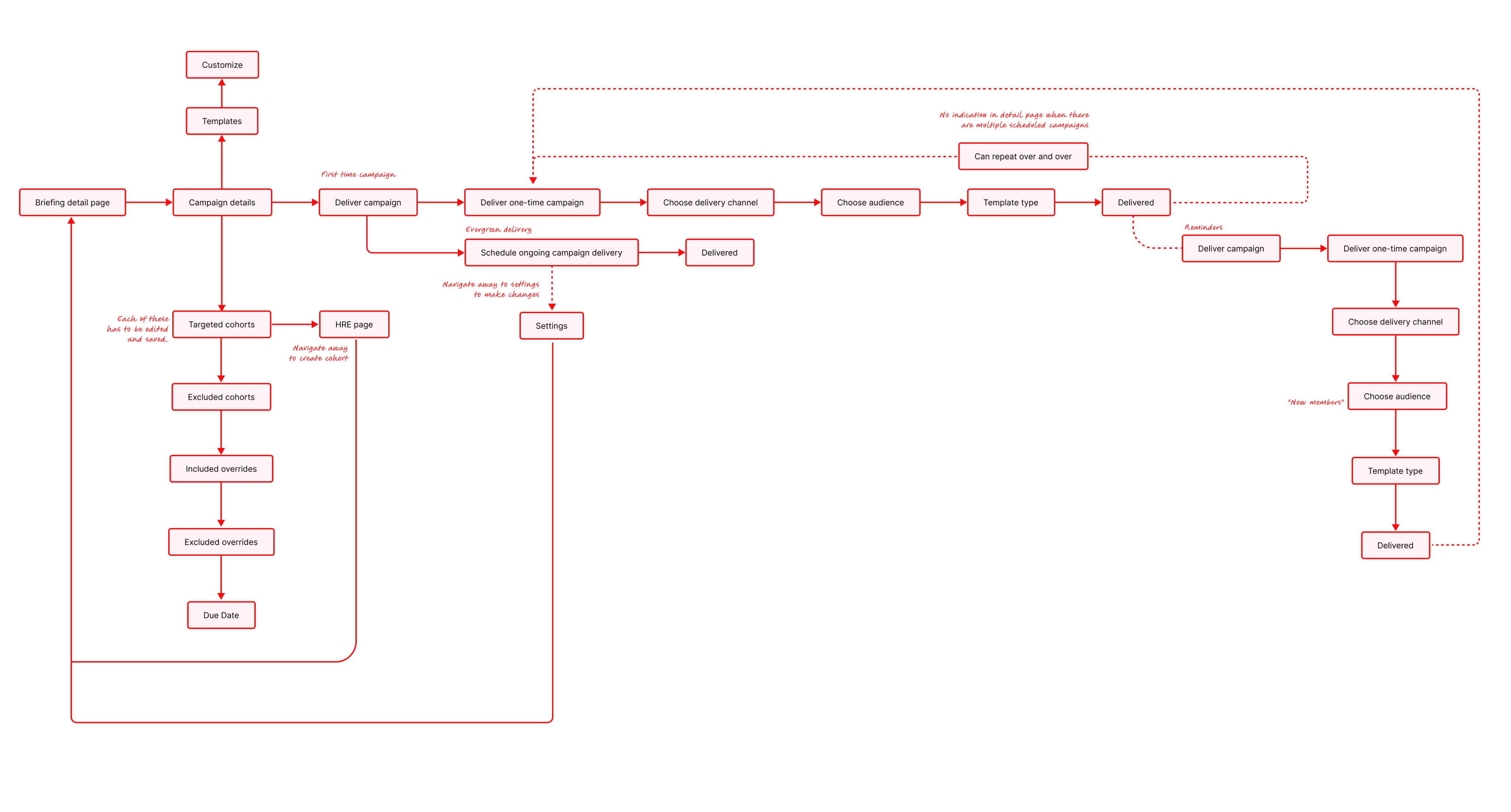
As customer volume and POV throughput accelerated after the Series A, we hit a bottleneck: customers couldn't complete core workflows without a Fable human, GTM, deployment engineers, or PM, in the loop. Users couldn't confirm what was configured, delivered, or successful without external support, and "evergreen" delivery literally meant a person re-sending campaigns manually.
Challenges
01
High-touch delivery was the default
Customers required GTM and deployment engineers to complete core workflows, limiting scalability as customer volume increased.
02
Workflow fragmentation across product modules
Briefings, simulations, and compliance training each followed different interaction models and system states, forcing admins to relearn delivery for every campaign type.
03
Time pressure and sequencing dependencies
We needed to improve time-to-value quickly without breaking existing functionality or overloading engineering bandwidth.
Success metrics
Efficiency
Steps to deliver a campaign with reminders, measured in-product (baseline ~16 clicks across 4 surfaces; target 8 clicks on 1 surface).
Reliability
First-attempt end-to-end delivery success: campaigns created, rendered, and delivered with zero manual intervention (target >95%).
Self-serve adoption
Share of campaigns delivered without Fable team involvement.
Operational load
Reduction in GTM/FDE hours spent supporting delivery per customer.
Personas
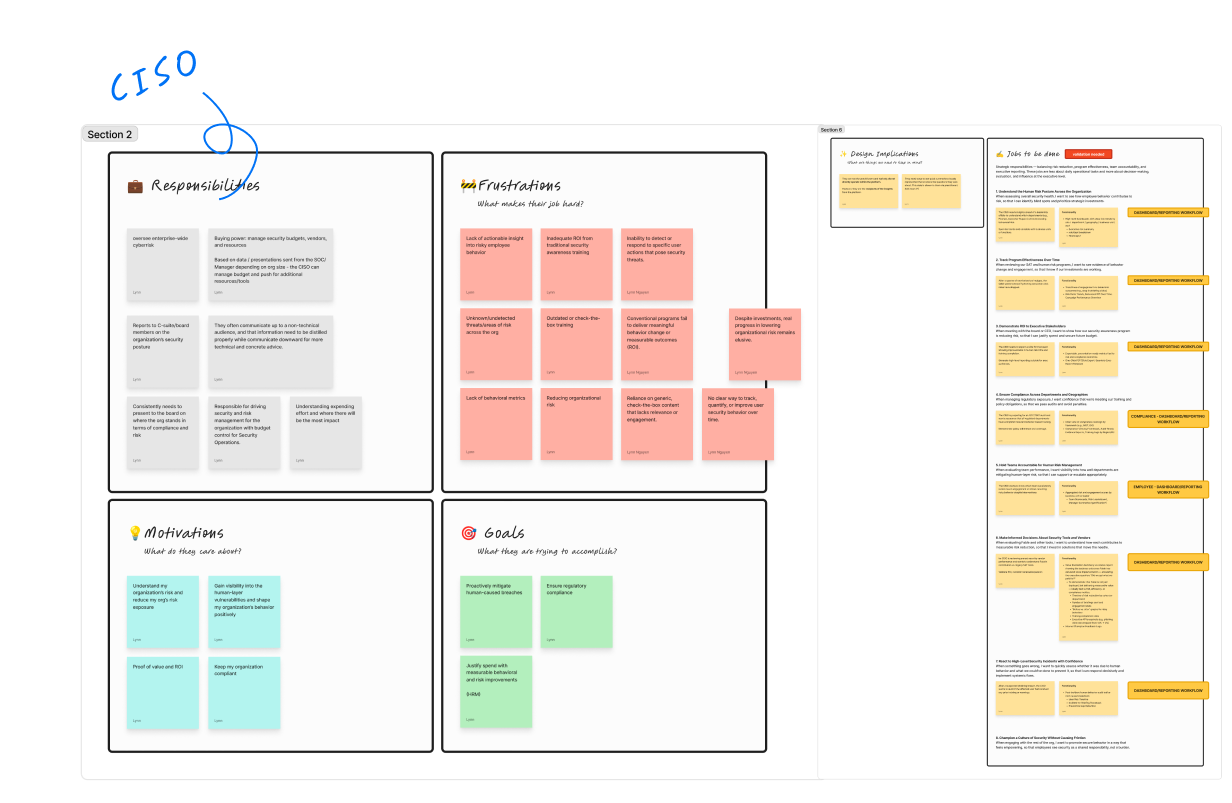
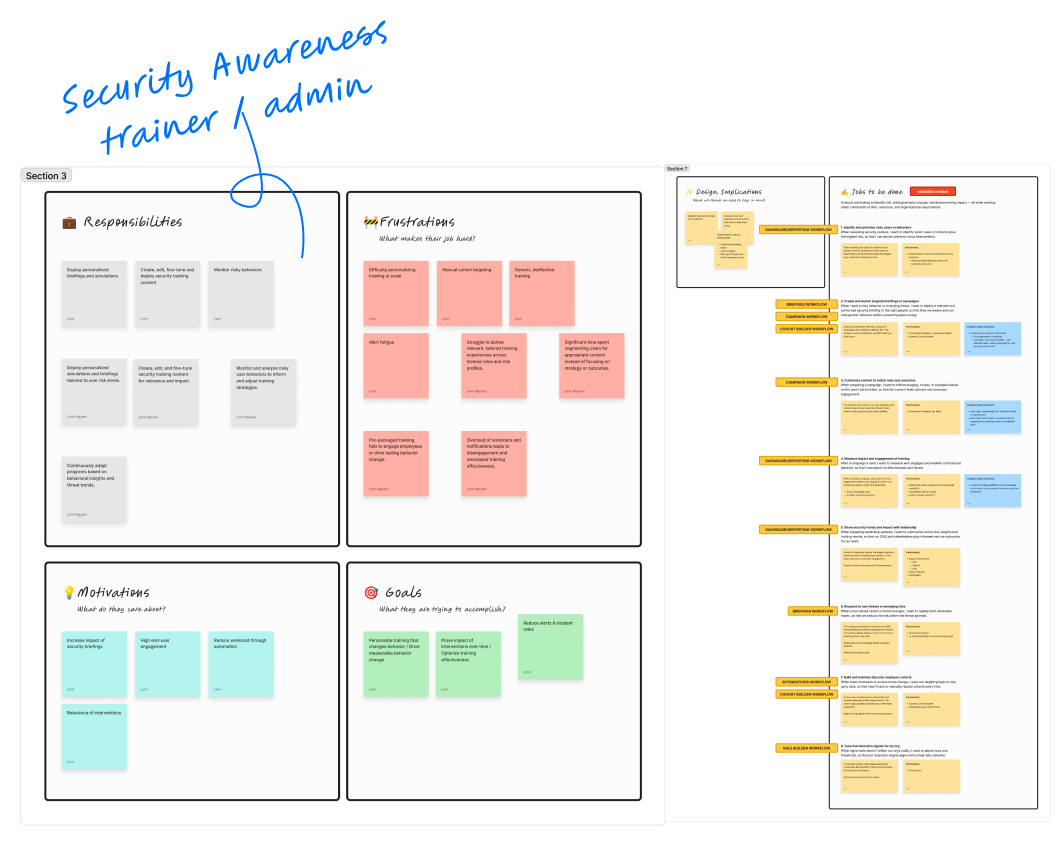
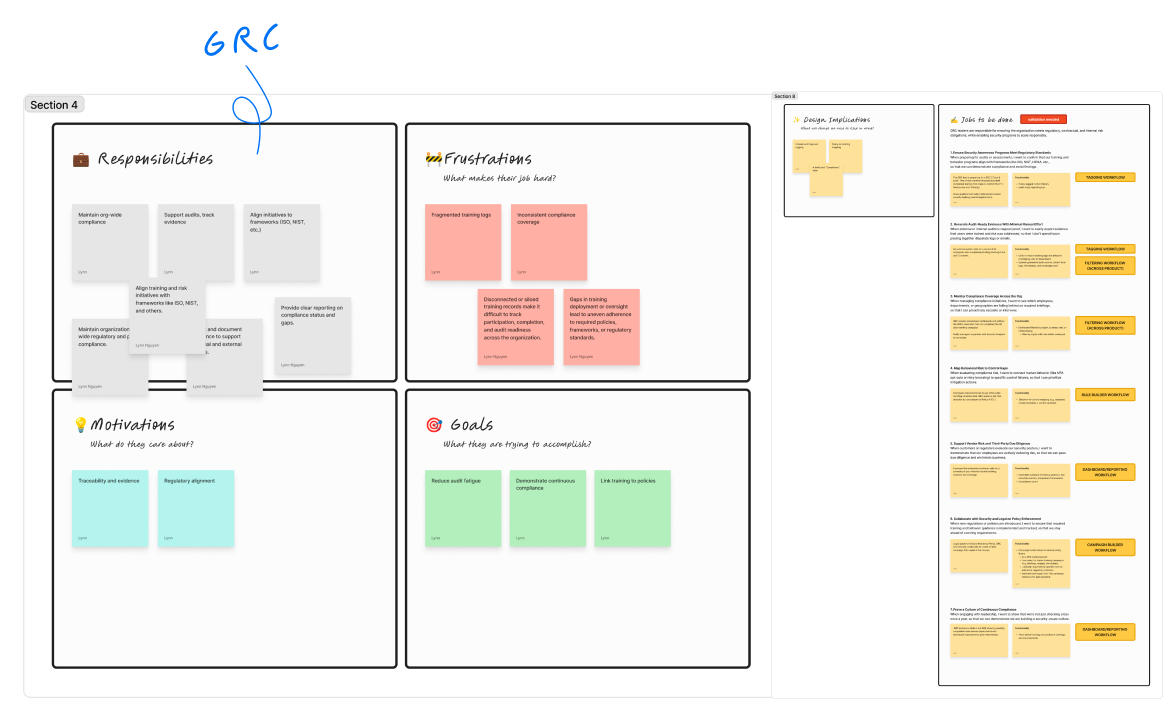
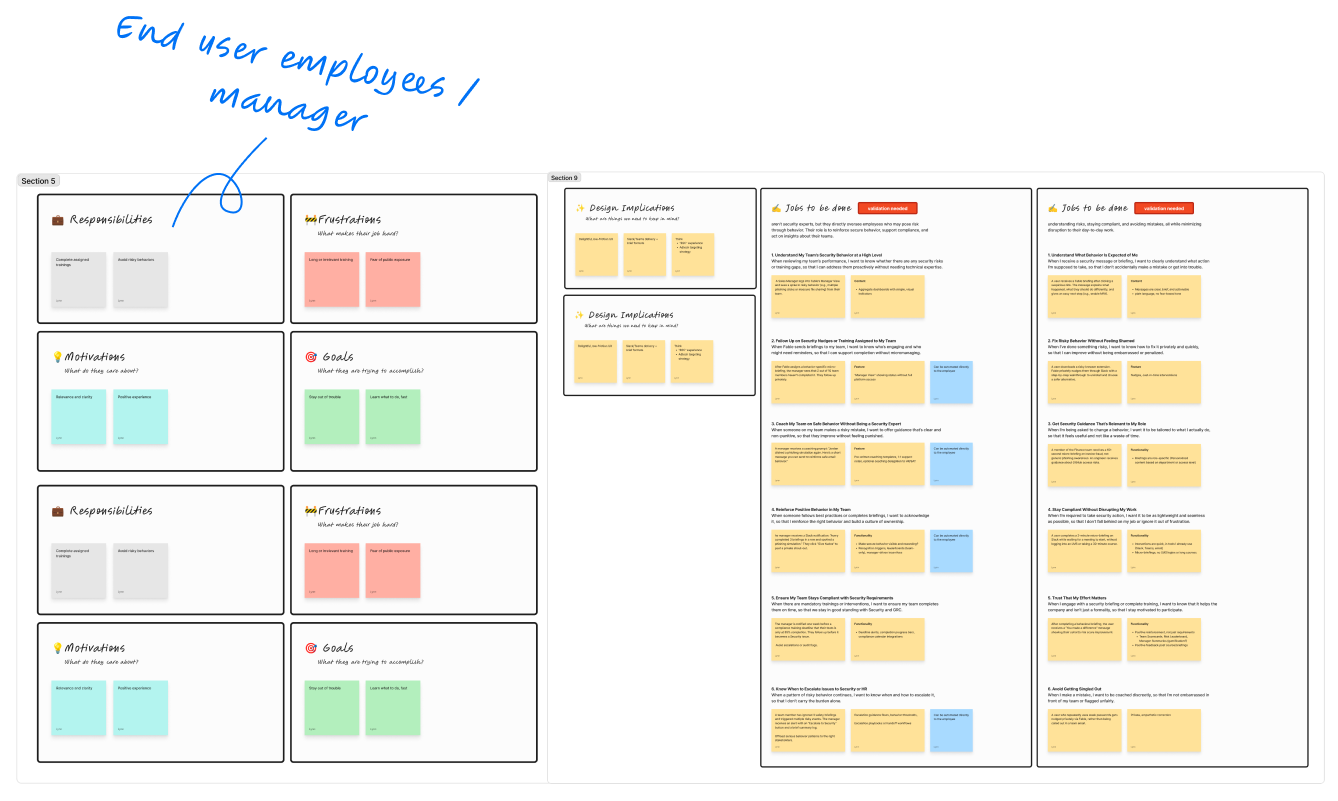
Research surfaced three personas with very different jobs but one shared dependency: a delivery model they could trust without help.
User Flows
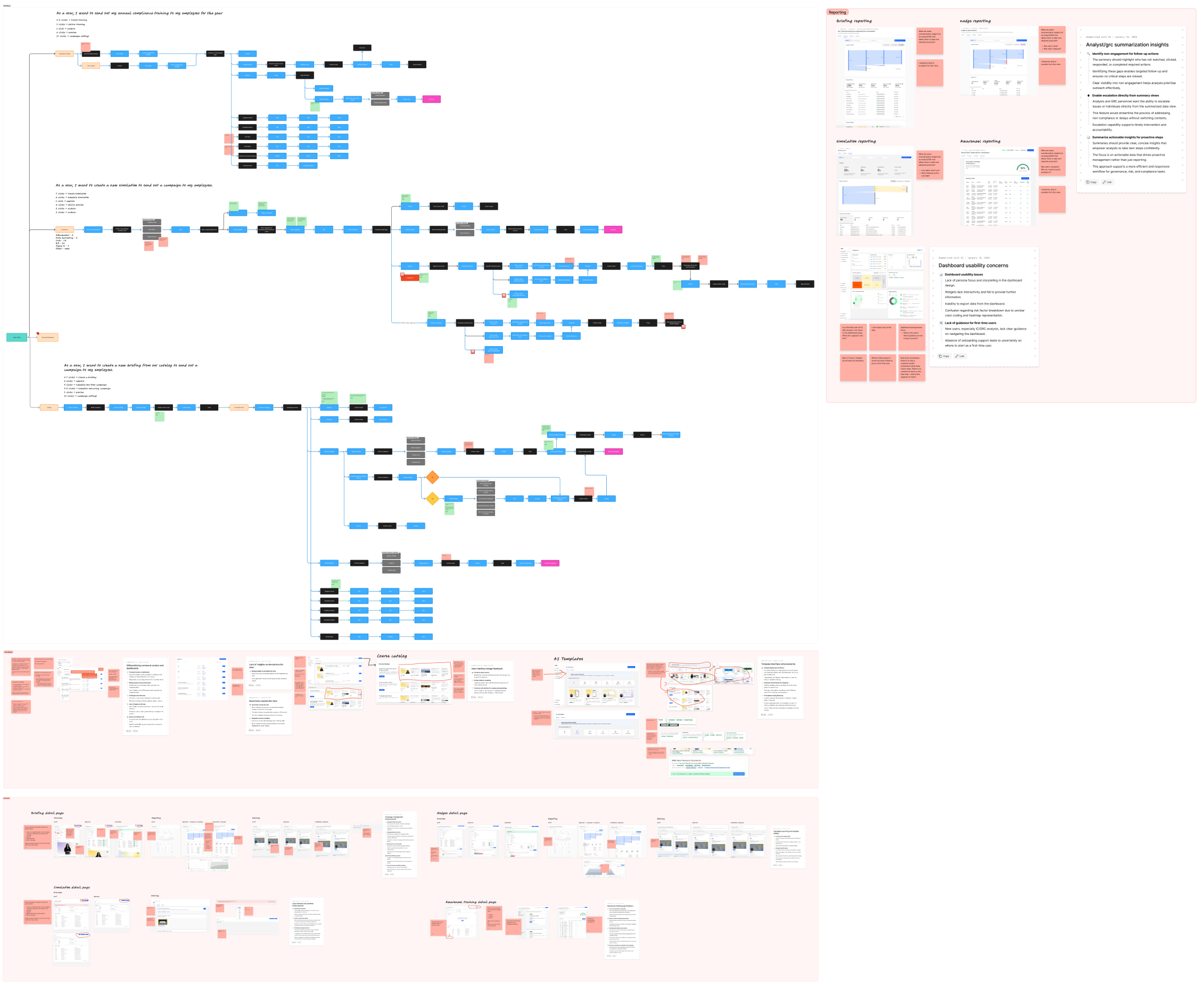
I mapped the end-to-end journey across our SKUs against the admin's jobs-to-be-done.
Common theme: no task-oriented entry into the product, slow and manual content personalization, and inconsistent delivery across campaign types.
Identify
User journey painpoints
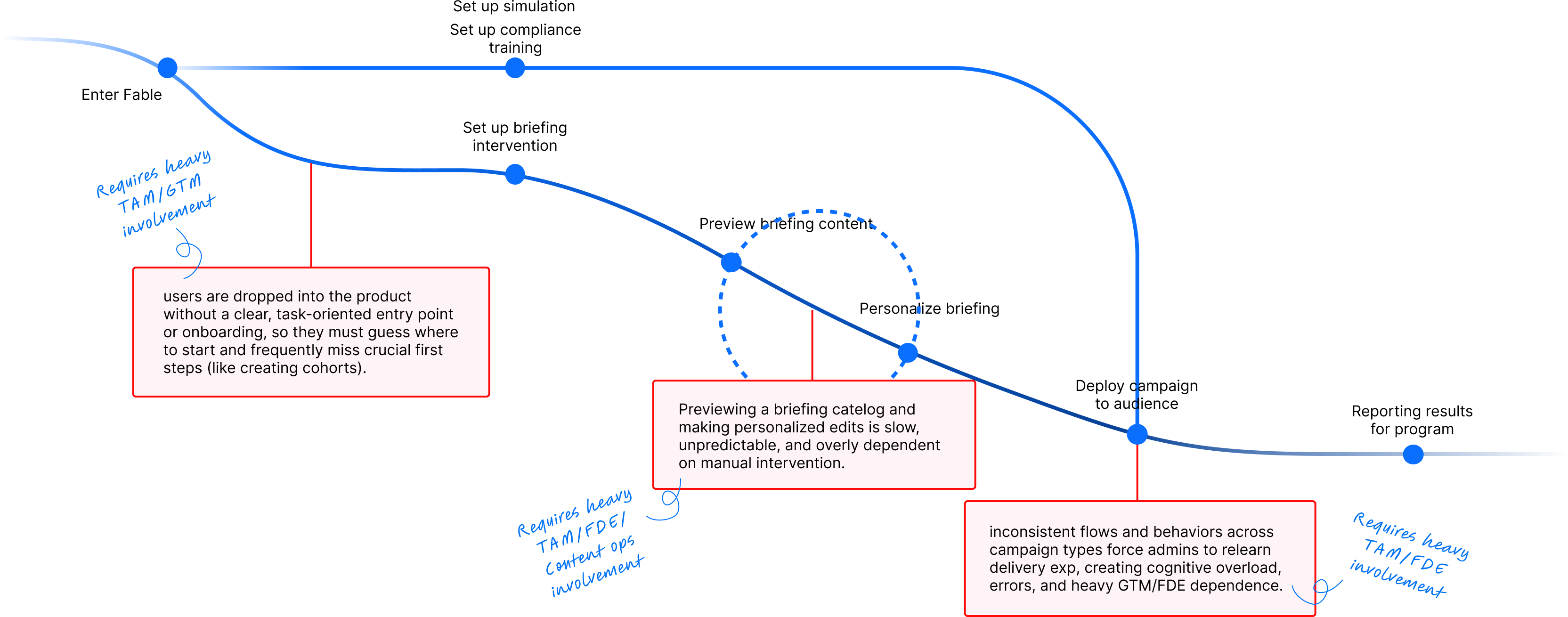
Delivery pain clustered into three themes: high friction and mental overload (delivery experience varied by campaign type), no campaign-level granularity (controls were global-only, scheduling locked to global defaults), and no delivery visibility (no lifecycle or overlap view, so scheduling conflicts were invisible).
Synthesis
Unify delivery to remove cognitive overload, reduce errors, and unburden GTM/Eng
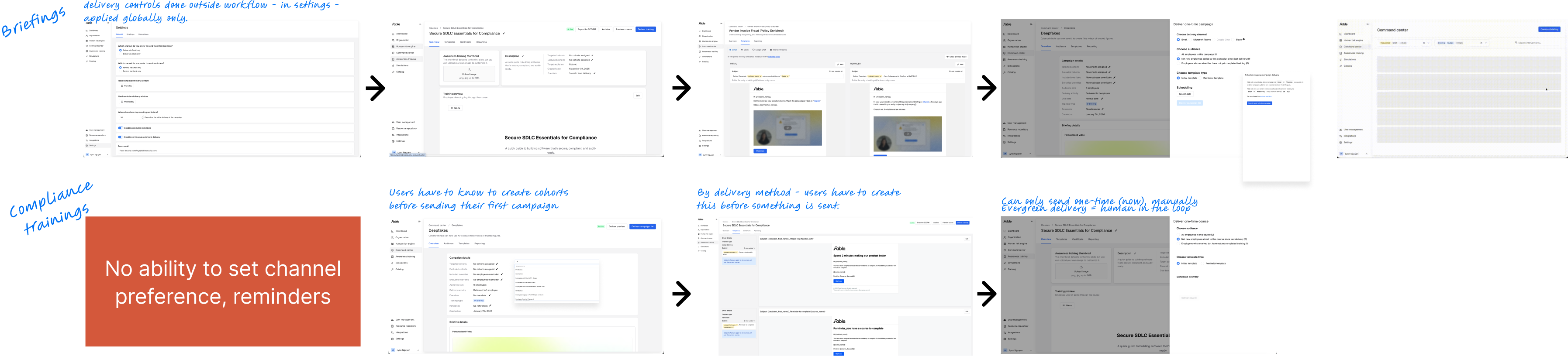
High Friction & Mental Overload
Delivery experience vary by campaign type, preventing a consistent mental model and causing cognitive overload.
Lack of Campaign-level Granularity
Delivery controls are global-only and users can’t make campaign-specific delivery customizations.
Scheduling is locked to global defaults; admins can’t override settings for urgent or exceptional campaigns.
Lack of Delivery Visibility
No clear delivery lifecycle or overlap view, leading to scheduling conflicts.
Wireframing
New Flow proposal
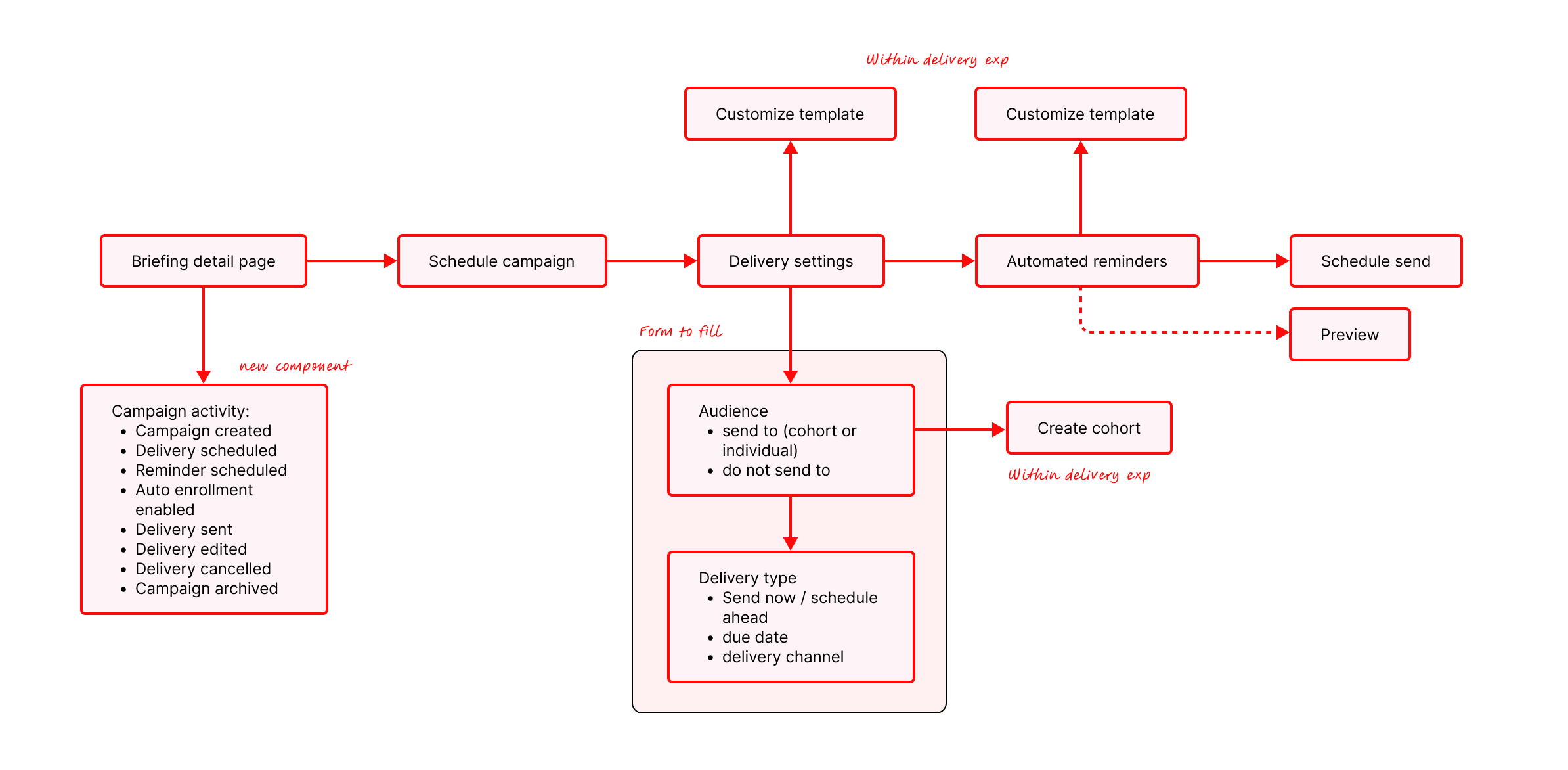
Leverage research from other similar delivery paradigms, worked closely with PM and Eng on a alternative workflow that can streamline a user’s experience.
- Aligning delivery expectation across both briefings and compliance:
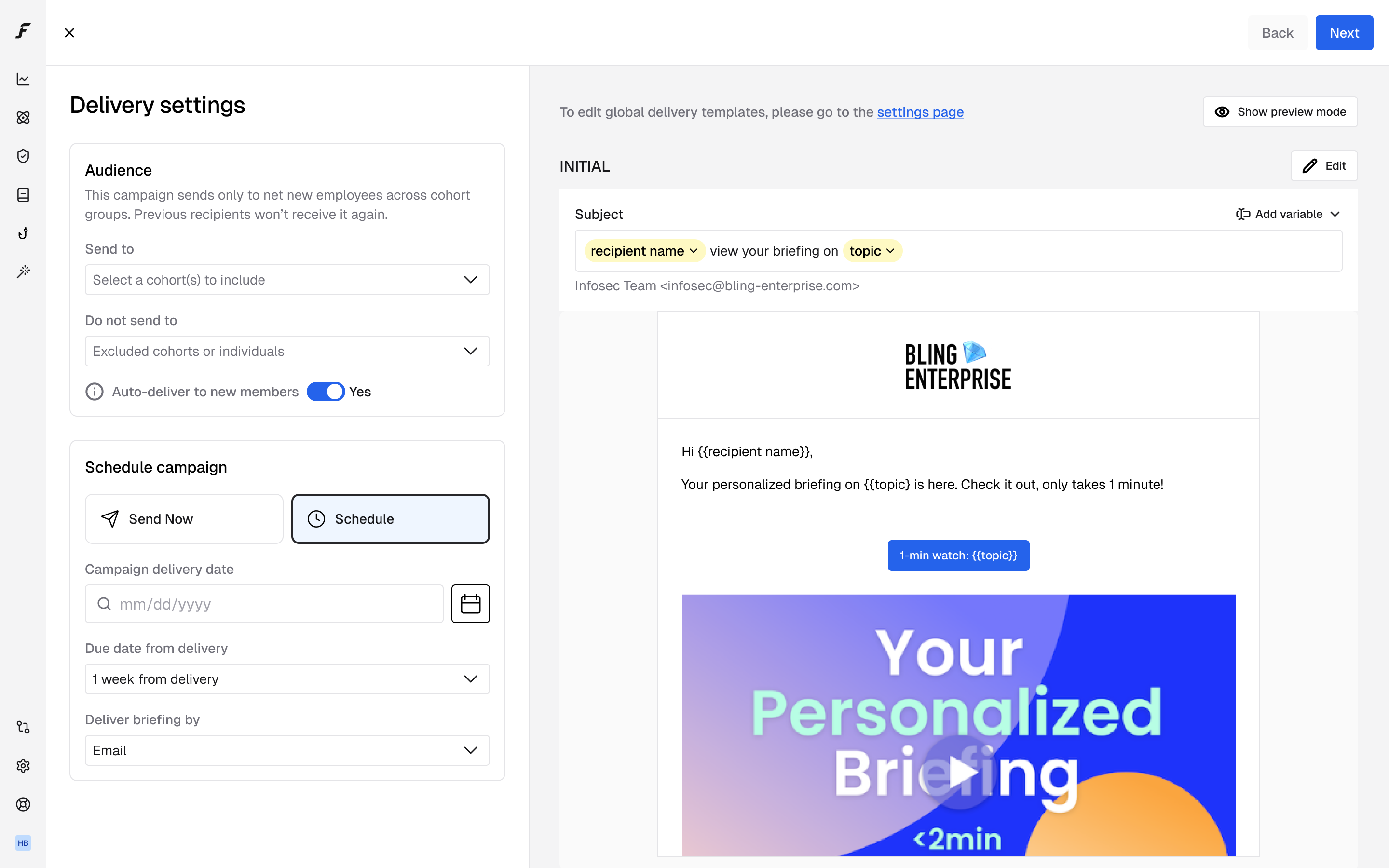
- As a user, I should be able to send now, schedule ahead, allow for evergreen deliveries and schedule reminders.
- As a user, I should be able to personalize the delivery method (email, slack, teams, etc).
MVP
The unified delivery experience brings the full delivery configuration into the campaign builder: audience, delivery type, channel, and reminders in one step per campaign. Delivery went from roughly 16 clicks across 4 surfaces with manual human intervention, down to 8 clicks on one surface with none human intervention.
Outcomes & what’s next?
We have had early feedback with a set small customers where we reviewed the designs. Additionally conducted sessions with GTM and received feedback on the updated experience. The MVP was scheduled to ship at the end of January 2026. I departed Fable shortly before release.
Takeaways
01
Design the pattern, not the feature. The delivery model we shipped for briefings became the paradigm other modules are adopting. Designing one surface well bought consistency everywhere.
02
Engineering constraints are design inputs. The release sequencing, the cohort pivot, and the component choices all came from designing with engineering's reality instead of around it.

Role: Lead Product Designer
Tools: Figma, Figjam, AI-Tools (Claude)
Team: Founders, GTM, Forward-Deployed Engineers, Product, Engineering
Timeline: Nov 2025 – Jan 2026
Enable Self-Serve: Unified Delivery
Fable Security is a Human Risk Management platform that detects risky employee behavior and delivers targeted interventions (micro-briefings, simulations, nudges) then measures whether behavior actually changed. After Fable announced its Series A in July 2025, the company shifted from building product to scaling go-to-market. This project focused on addressing campaign delivery and enable customers to self-serve without GTM/FDE support.
Responsibilities
I was the product designer leading design at Fable. I ran the product assessment end to end which became the foundation of the Q3 roadmap. Based on the investigation, I designed of the unified delivery experience through release, partnering with FDEs, GTM, product management, and the founders.
PROBLEM STATEMENT
The problem
As customer volume and POV throughput accelerated after the Series A, we hit a bottleneck: customers couldn't complete core workflows without a Fable human, GTM, deployment engineers, or PM, in the loop. Users couldn't confirm what was configured, delivered, or successful without external support, and "evergreen" delivery literally meant a person re-sending campaigns manually.
Challenges
01
High-touch delivery was the default
Customers required GTM and deployment engineers to complete core workflows, limiting scalability as customer volume increased.
02
Workflow fragmentation across product modules
Briefings, simulations, and compliance training each followed different interaction models and system states, forcing admins to relearn delivery for every campaign type.
03
Time pressure and sequencing dependencies
We needed to improve time-to-value quickly without breaking existing functionality or overloading engineering bandwidth.
Success metrics
Efficiency
Steps to deliver a campaign with reminders, measured in-product (baseline ~16 clicks across 4 surfaces; target 8 clicks on 1 surface).
Reliability
First-attempt end-to-end delivery success: campaigns created, rendered, and delivered with zero manual intervention (target >95%).
Self-serve adoption
Share of campaigns delivered without Fable team involvement.
Operational load
Reduction in GTM/FDE hours spent supporting delivery per customer.
Personas
Research surfaced three personas with very different jobs but one shared dependency: a delivery model they could trust without help.
User Flows
I mapped the end-to-end journey across our SKUs against the admin's jobs-to-be-done.
Common theme: no task-oriented entry into the product, slow and manual content personalization, and inconsistent delivery across campaign types.
Identify
User journey painpoints
Delivery pain clustered into three themes: high friction and mental overload (delivery experience varied by campaign type), no campaign-level granularity (controls were global-only, scheduling locked to global defaults), and no delivery visibility (no lifecycle or overlap view, so scheduling conflicts were invisible).
Synthesis
Unify delivery to remove cognitive overload, reduce errors, and unburden GTM/Eng
High Friction & Mental Overload
Delivery experience vary by campaign type, preventing a consistent mental model and causing cognitive overload.
Lack of Campaign-level Granularity
Delivery controls are global-only and users can’t make campaign-specific delivery customizations.
Scheduling is locked to global defaults; admins can’t override settings for urgent or exceptional campaigns.
Lack of Delivery Visibility
No clear delivery lifecycle or overlap view, leading to scheduling conflicts.
Wireframing
New Flow proposal
Leverage research from other similar delivery paradigms, worked closely with PM and Eng on a alternative workflow that can streamline a user’s experience.
- Aligning delivery expectation across both briefings and compliance:
- As a user, I should be able to send now, schedule ahead, allow for evergreen deliveries and schedule reminders.
- As a user, I should be able to personalize the delivery method (email, slack, teams, etc).
MVP
The unified delivery experience brings the full delivery configuration into the campaign builder: audience, delivery type, channel, and reminders in one step per campaign. Delivery went from roughly 16 clicks across 4 surfaces with manual human intervention, down to 8 clicks on one surface with none human intervention.
Outcomes & what’s next?
We have had early feedback with a set small customers where we reviewed the designs. Additionally conducted sessions with GTM and received feedback on the updated experience. The MVP was scheduled to ship at the end of January 2026. I departed Fable shortly before release.
Takeaways
01
Design the pattern, not the feature. The delivery model we shipped for briefings became the paradigm other modules are adopting. Designing one surface well bought consistency everywhere.
02
Engineering constraints are design inputs. The release sequencing, the cohort pivot, and the component choices all came from designing with engineering's reality instead of around it.
Enable Self-Serve: Unified Delivery
Fable Security is a Human Risk Management platform that detects risky employee behavior and delivers targeted interventions (micro-briefings, simulations, nudges) then measures whether behavior actually changed. After Fable announced its Series A in July 2025, the company shifted from building product to scaling go-to-market. This project focused on addressing campaign delivery and enable customers to self-serve without GTM/FDE support.
Responsibilities
I was the product designer leading design at Fable. I ran the product assessment end to end which became the foundation of the Q3 roadmap. Based on the investigation, I designed of the unified delivery experience through release, partnering with FDEs, GTM, product management, and the founders.
Role: Lead Product Designer
Tools: Figma, Figjam, AI-Tools (Claude)
Team: Founders, GTM, Forward-Deployed Engineers, Product, Engineering
Timeline: Nov 2025 – Jan 2026
PROBLEM STATEMENT
The problem
As customer volume and POV throughput accelerated after the Series A, we hit a bottleneck: customers couldn't complete core workflows without a Fable human, GTM, deployment engineers, or PM, in the loop. Users couldn't confirm what was configured, delivered, or successful without external support, and "evergreen" delivery literally meant a person re-sending campaigns manually.
Challenges
01
High-touch delivery was the default
Customers required GTM and deployment engineers to complete core workflows, limiting scalability as customer volume increased.
02
Workflow fragmentation across product modules
Briefings, simulations, and compliance training each followed different interaction models and system states, forcing admins to relearn delivery for every campaign type.
03
Time pressure and sequencing dependencies
We needed to improve time-to-value quickly without breaking existing functionality or overloading engineering bandwidth.
Success metrics
Efficiency
Steps to deliver a campaign with reminders, measured in-product (baseline ~16 clicks across 4 surfaces; target 8 clicks on 1 surface).
Reliability
First-attempt end-to-end delivery success: campaigns created, rendered, and delivered with zero manual intervention (target >95%).
Self-serve adoption
Share of campaigns delivered without Fable team involvement.
Operational load
Reduction in GTM/FDE hours spent supporting delivery per customer.
Personas
Research surfaced three personas with very different jobs but one shared dependency: a delivery model they could trust without help.
User Flows
I mapped the end-to-end journey across our SKUs against the admin's jobs-to-be-done.
Common theme: no task-oriented entry into the product, slow and manual content personalization, and inconsistent delivery across campaign types.
Identify
User journey painpoints
Delivery pain clustered into three themes: high friction and mental overload (delivery experience varied by campaign type), no campaign-level granularity (controls were global-only, scheduling locked to global defaults), and no delivery visibility (no lifecycle or overlap view, so scheduling conflicts were invisible).
Synthesis
Unify delivery to remove cognitive overload, reduce errors, and unburden GTM/Eng
High Friction & Mental Overload
Delivery experience vary by campaign type, preventing a consistent mental model and causing cognitive overload.
Lack of Campaign-level Granularity
Delivery controls are global-only and users can’t make campaign-specific delivery customizations.
Scheduling is locked to global defaults; admins can’t override settings for urgent or exceptional campaigns.
Lack of Delivery Visibility
No clear delivery lifecycle or overlap view, leading to scheduling conflicts.
Wireframing
New Flow proposal
Leverage research from other similar delivery paradigms, worked closely with PM and Eng on a alternative workflow that can streamline a user’s experience.
- Aligning delivery expectation across both briefings and compliance:
- As a user, I should be able to send now, schedule ahead, allow for evergreen deliveries and schedule reminders.
- As a user, I should be able to personalize the delivery method (email, slack, teams, etc).
MVP
The unified delivery experience brings the full delivery configuration into the campaign builder: audience, delivery type, channel, and reminders in one step per campaign. Delivery went from roughly 16 clicks across 4 surfaces with manual human intervention, down to 8 clicks on one surface with none human intervention.
Outcomes & what’s next?
We have had early feedback with a set small customers where we reviewed the designs. Additionally conducted sessions with GTM and received feedback on the updated experience. The MVP was scheduled to ship at the end of January 2026. I departed Fable shortly before release.
Takeaways
01
Design the pattern, not the feature. The delivery model we shipped for briefings became the paradigm other modules are adopting. Designing one surface well bought consistency everywhere.
02
Engineering constraints are design inputs. The release sequencing, the cohort pivot, and the component choices all came from designing with engineering's reality instead of around it.